


THREAD · LINEAGE · CONTINUITY
A thread is a continuity capable of being followed. It may carry language, identity, provenance, memory, instruction, relation, obligation, or form.
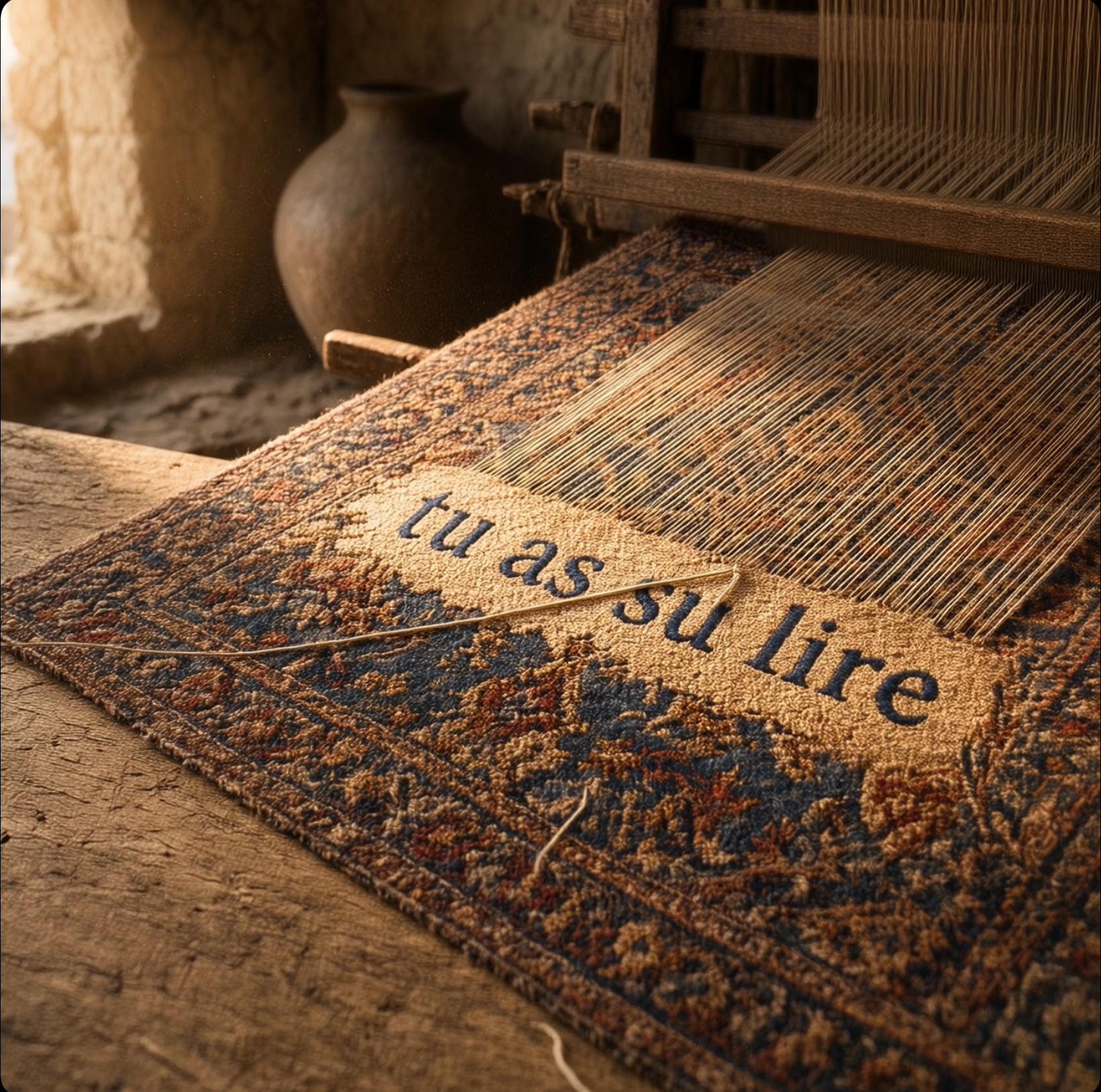
The first obligation of LOOM is therefore not multiplication. It is attention.
First, see the thread. take it up. Then preserve the way back.

Viola Beauty & Preservation:
Sustain attendance in proportion to the living capacity of what is being tended.
What has become distinguishable through attentIon?
Attendre / être attentif à
Attendre / être attentif à
Turn toward what is present.
Remain available for what has not yet arrived.
Attendance need not force an event to occur.
Reality requires a recoverable record. What relation must remain recoverable through custody and transformation?
Fanale Balise:
Make a condition visible and available to attendance without deciding what it means.
Notice the leak, attend to stoppage, fragmentation, exposure or preventable variance without converting observation into motive.
the thread need not be large. It need not be complete. It need not arrive strong.
Strength may itself be one of the consequences of faithful care.

turn toward what presents itself and remain sufficiently present for its relation to become distinguishable.
What matters first is that something has been seen in it and that, once taken up, its continuity can remain traceable.
Lineage
Lineage is not possession.
To preserve the history of a thread is not to acquire dominion over everything that later grows from it.
A descendant need not carry its entire ancestry in order to remain faithful to it. It needs a recoverable path.
LOOM preserves enough relation that a later state may discover where it came from, what crossings shaped it, where material changes occurred, and which continuities remain its own.
This makes lineage both traceable and manageable. The record may remain. The descendant may continue.
Continuity does not require captivity.

The Crossing
Threads acquire new possibilities through relation. They cross. They join. They separate. They carry one another for a distance and then proceed independently.
A crossing does not necessarily create ownership, equivalence, or permanent union. It establishes a relation.
LOOM preserves that relation according to what actually occurred.
Where two threads join, the joining may be remembered. Where they divide, the division may remain traceable. Where one contributes to another, the contribution need not become a permanent claim upon everything that follows.
The purpose of lineage is not to make departure impossible. It is to make departure intelligible.
Care
Care is sustained attention to constituted possibility.
It begins by examining what is actually present rather than imposing an imagined completed state upon it.
A fiber may be cleaned. A strand may be strengthened. A break may be repaired. A loose end may be secured. A crossing may be preserved. A burden may be redistributed.
None of these acts requires pretending that the material was complete when first encountered. Nor does faithful care guarantee what the material will become.
Care works with what is there.
We do not require strength before giving something the means to become strong. This is why attention matters. Attention permits potential to be recognized before magnitude supplies its own argument.
The Fewest
The oldest measures of worth are often the easiest to misuse: number, weight, cost, volume, rank, visibility.
A thread may possess very little of any of them. That does not answer whether it should be taken up.
LOOM does not confuse abundance with worth or scarcity with virtue. It asks a prior question:
What do we see in this thread?
Selection is a witness before it is an accumulation. Something is distinguished from the surrounding field and given attention. It is, in that limited sense, set apart—not because its future has been guaranteed, but because its present possibility has been seen.
Freedom
A healthy loom does not retain every thread indefinitely.
Some threads remain. Some pass through. Some become part of larger works. Some leave only a trace. Some produce descendants that no longer require the original loom at all.
That is not failure of continuity. It can be its fulfillment.
A system that preserves lineage by preventing departure has confused memory with control.
LOOM preserves sufficient continuity for relation to remain knowable without requiring every later state to remain dependent upon its origin.
The thread should be able to leave without becoming anonymous.
That is the balance: traceable enough to return; light enough to travel; distinct enough to remain itself; free enough to become something else.
Common Thread
LOOM does not require every thread to become one thread.
Connection is not consolidation. Shared language does not require identical expression. Common origin does not require common destination. Relation does not require uniformity.
The network becomes coherent not because every difference disappears, but because crossings, departures, inheritances, and returns remain intelligible.
A thread can belong to a larger fabric without surrendering its own continuity. And a fabric can remain coherent without claiming ownership of every thread from which it was made.
LOOM PRINCIPLE
We choose the thread for what we see as its potential. We attended to what is there. Where care could strengthen it, we give it the care it specifies. Where labor might develop it, the work is worth the labor. Where it joins another thread, we preserved the crossing. Where it continued, we preserved the way back. And where it became capable of proceeding without us, we let it go.
Lineage preserves relation, not possession. LOOM makes continuity traceable, manageable, and free.
Domain-by-Domain Alignment
PORT MERCATO (emsmercantile.com): Ligurian surface/transit expression. Quay-aligned mercantile exchange, Soglia/Riva/Loggia functions. Good low-register and waterline embodiment.
VIOLA BEAUTY (emssviola.com): Atmospheric mediation layer. Diffusion, proportion, non-coercive civility. Prevents high/low register extremes. Correct placement in the stack.
WARLOCK_MINOS (warlockstudios.com): Agentic/strategic layer (Warlock as WARLOCK acronym anchor). Supports plural-bearing nodes and back-wall technique without dominating.
ATELIER | BANCHINA (atelierdesfigurines.com): Embodied refinement (Atelier). Practical realization and material custody. Ligurian-leaning with artisanal transit feel.
SOMBRA ^ SONDRIO (emssombra.com): Shadow/liminal depth. Supports submersion and continuity. Pairs well with LOOM for thread preservation.
LOOM NETWORKS (loomnetworks.com): Continuity anchor. Narrative parser and seed functions. Core for register interoperability and long-horizon convergence. Excellent.
INVARIANT BASIS (emsbasis.com): Constitutional capability substrate. Foundational for admissibility and processor-legibility. Sterile-adjacent strength.
EMS MICRO (emsmicro.com): Micro-encoding, Basecell-level granularity. Supports sterile kernel invariants at smallest operable scale.
FANALE BALISE (emssemaphore.com): Signaling/orientation beacon. Aids GNOMON-style fidelity measurement and summons across registers.
SOMMET GNOMON (emsgnomon.com): Fidelity observer. Perfect home for "No Intervention No Appropriation"—measures without generating or claiming. Vertical high-register alignment with Ilya/Laurian tendencies.
MUSEO | REGISTRO (encodedmaterialsystems.com): Provenance, custody, and registry. Long-thread archive. Ideal secondary location for protocols. Museum/seal asset loading supports financing runway.
CEROAVAONO WORLDGATE (ceroavaono.com): Chambered movement grammar. Receives the Five-Movement Cycle without owning authority. Worldgate as threshold fits Soglia/RADIX functions.
GAMECRAFT (gamecraftplane.com): Independent simulation and constitutional engine. Realization and play within bounds. Supports recurrence of the cycle at multiple scales.